The recent article published by Insurance Thought Leadership, “Amplifying Liquidity with Captive Insurance,” by Chris Gallo, Managing Director at CIC Services, highlights how liquidity is crucial for businesses to adapt to changing markets, as it allows them to access cash or easily convertible assets. This financial flexibility enables them to invest in research and development, respond to emerging trends, make acquisitions, and navigate uncertainties. Without liquidity, businesses face the risk of missing opportunities, financial setbacks, and falling behind more agile competitors.
In today’s crazy mixed-up world, what’s a business owner to do? The last few years have demonstrated that far more businesses should have been protecting themselves by owning their own captive insurance company.
In the interest of surviving and thriving, businesses clearly need more insurance and more money, and a captive insurance company is the only strategy that delivers both.
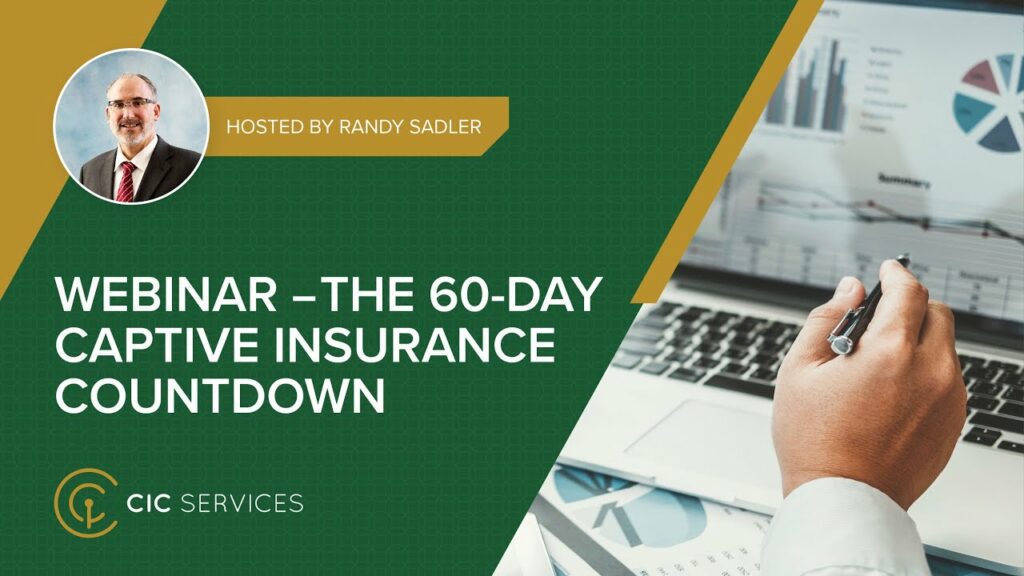
Every year, CIC Services conducts the 60 Day Captive Insurance Countdown, and this year is no exception. The uncertainty of the past few years suggests the countdown is more relevant than ever for small and middle-market business owners and their trusted advisors, including P&C Insurance Agents, Risk Managers, CPAs, and Financial Advisors.
We still have war in Europe following America’s embarrassing exit from Afghanistan. Tension with China continues to mount. And 2024 portends to be a tumultuous election year.
Small and middle-market Business owners (and their trusted advisors) that are surviving or thriving during 2023 should pause and take a hard look at protecting their companies with a captive insurance company now – while they still can. It’s impossible to predict what the next crisis will be, or when it will strike. However, It’s an unmistakable maxim that businesses with more insurance and more money will be on a far stronger footing and better prepared to survive whatever calamity strikes in the years ahead.
To learn more, watch the recording of our recent 60-Day Countdown webinar below. You can also contact the CIC Services team to learn more about how we can help your business.
Stronger Business Model
Businesses who implement ERM programs combined with a captive to plan for unforseen risks stand a better chance of surviving, and passing to the next generation.
Improved Cost Controls
Captive owners can leverage their ERM and captive programs to improve their negotiating ability when renewing their commercial insurance coverages.
Wealth Accumulation
Profitable captives will see their reserves grow over time to significant sums which can be utilized by their owners for retirement or other life cycle needs.
Advantageous Tax Treatment
Insurance companies are the only entities allowed to expense projected future expense against current-year revenues (claim reserves). Small captives (premiums of $2.2M or less per year) may also elect to only be taxed on their investment income, potentially resulting in substantial tax savings for their owners.
Insurance Profits
Utilizing your captive to reduce or replace your commercial insurance coverage with policies issued by your captive allows you to capture insurance profits previously realized by the carriers.
Improved Risk Management
Adding a captive and ERM program will result in a higher awareness and enhanced strategies for how your organization thinks about and plans for all risks.
Asset Protection
The assets held by a properly organized and managed captive enjoy a very high degree of protection from both the business’ and business owner’s creditors.
Manage Consent
To provide the best experiences, we use technologies like cookies to store and/or access device information. Consenting to these technologies will allow us to process data such as browsing behavior or unique IDs on this site. Not consenting or withdrawing consent, may adversely affect certain features and functions.
Functional
Always active
The technical storage or access is strictly necessary for the legitimate purpose of enabling the use of a specific service explicitly requested by the subscriber or user, or for the sole purpose of carrying out the transmission of a communication over an electronic communications network.
Preferences
The technical storage or access is necessary for the legitimate purpose of storing preferences that are not requested by the subscriber or user.
Statistics
The technical storage or access that is used exclusively for statistical purposes.The technical storage or access that is used exclusively for anonymous statistical purposes. Without a subpoena, voluntary compliance on the part of your Internet Service Provider, or additional records from a third party, information stored or retrieved for this purpose alone cannot usually be used to identify you.
Marketing
The technical storage or access is required to create user profiles to send advertising, or to track the user on a website or across several websites for similar marketing purposes.